Into Wallacea: The Complete Diver's Guide to South Halmahera
A volcanic island chain within the Coral Triangle where tidal currents funnel through narrow straits to concentrate pelagic life, house reefs hold extraordinary species diversity, and the walking shark — endemic to these islands — prowls the reef at night.
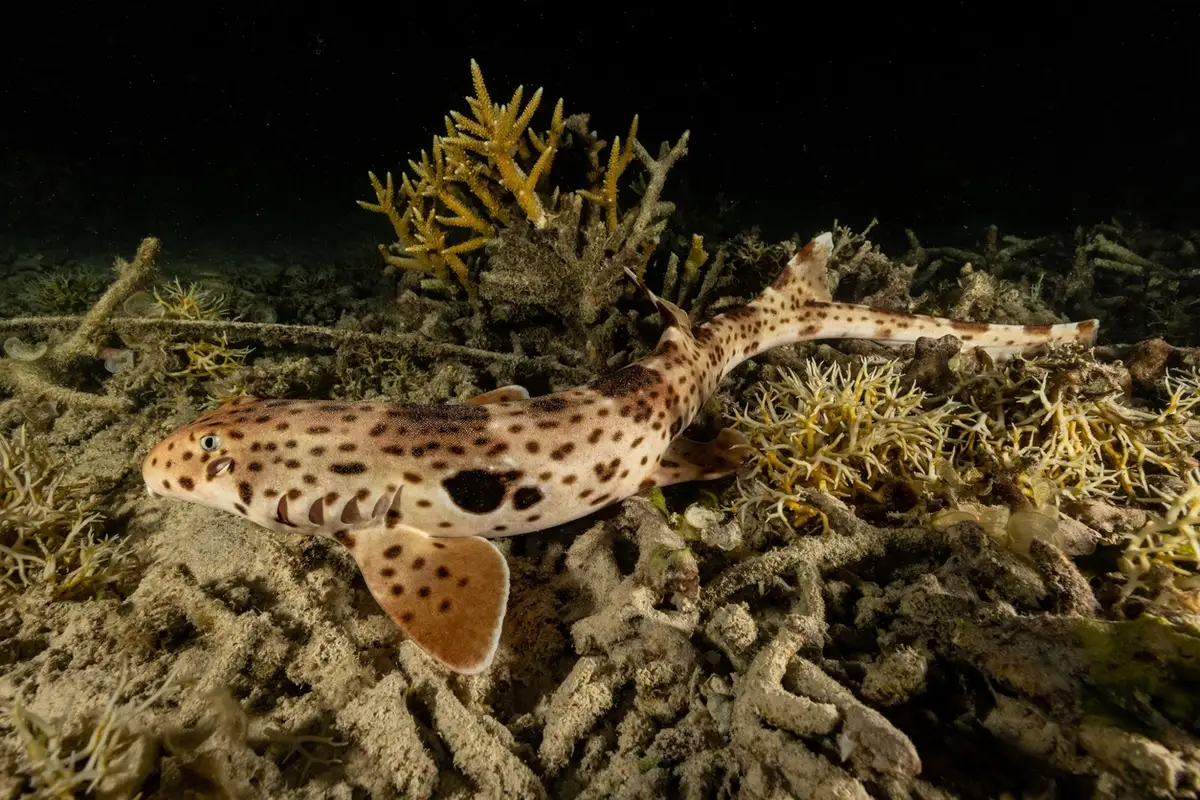
South Halmahera lies within Wallacea, the biogeographic transition zone between the Asian and Australian faunal regions where evolutionary isolation over millions of years has produced a concentration of species found nowhere else on earth. The region sits within the Coral Triangle, and its volcanic geology and nutrient-driven currents sustain an underwater environment of exceptional richness. The most remarkable of its endemic species, the Halmahera Epaulette Shark, moves across the reef floor on its pectoral and pelvic fins rather than swimming. It does not swim to where it is going. It walks.
The diving divides into two distinct characters. The Patinti Strait runs between Halmahera's southern coast and a cluster of barrier islands — Proco, Gala, Saleh Besar, Saleh Kecil, and Nanas — whose geography constricts tidal flow into high-velocity currents that concentrate marine life with unusual efficiency. On either side of the strait, the calmer reefs and marine sanctuaries of Sali Kecil, Kusu Island, and the outer Goraici archipelago offer a different register: coral-dense environments suited to slower and more sustained exploration. Bacan Island, bounding the western side of the strait, adds a third character — volcanic black sand, macro-rich slopes, and one of the region's few accessible wreck sites.
At a Glance
| Best time to visit | June to October |
| Diving season | Year-round |
| Water temperature | 27°C - 30°C (occasionally 25°C with upwellings) |
| Visibility | Up to 40m (June-October); sheltered bays remain clear in wet season |
| Whale sharks | October to December |
| Getting there | Fly to Ternate (TTE) or Labuha (LAH); 1-3 hrs resort speedboat |
The Patinti Strait
The Patinti Strait operates as a biological engine. The barrier islands — Proco, Gala, Saleh Besar, Saleh Kecil, and Nanas — constrict the tidal flow between the northern and southern Maluku Sea, creating high-velocity currents that carry deep-water nutrients upward and concentrate pelagic life in a way few channels in the region match. The key variable is timing: the sites here are most productive at tidal change, when shifts in current direction bring migrating animals to the surface and trigger peaks in fish biomass worth planning a dive around.
Proco Channel, running between Nanas and Saleh Kecil, is the signature drift site. Steep underwater canyons lined with vibrant soft corals and gorgonians form a corridor for grey reef sharks, eagle rays, barracuda, and trevally riding the current. Tobias Point, a surfacing rock at the northern tip of Saleh Besar, is connected to an underwater ridge and is known for exceptional shark activity — blacktip and grey reef sharks working the slope, and dense aggregations of anthias in the shallows. Batu Jabu, sitting in the middle of the channel between the mainland and Saleh Besar, produces intense and unpredictable fish action that peaks at tidal change. Ric's Rock is a current-swept site with the character of an open-water encounter. The Tower, on the mainland coast, offers a contrasting approach: a sloping reef in the shallows dense with Acropora hard coral and Dendronephthya soft coral, dropping to a deep mineral plateau. When the main strait is running too hard, Karang Hitam — a submerged reef with a sheltered lee side — provides reliable conditions for the closer, slower observation the turbulent channel sites do not allow.
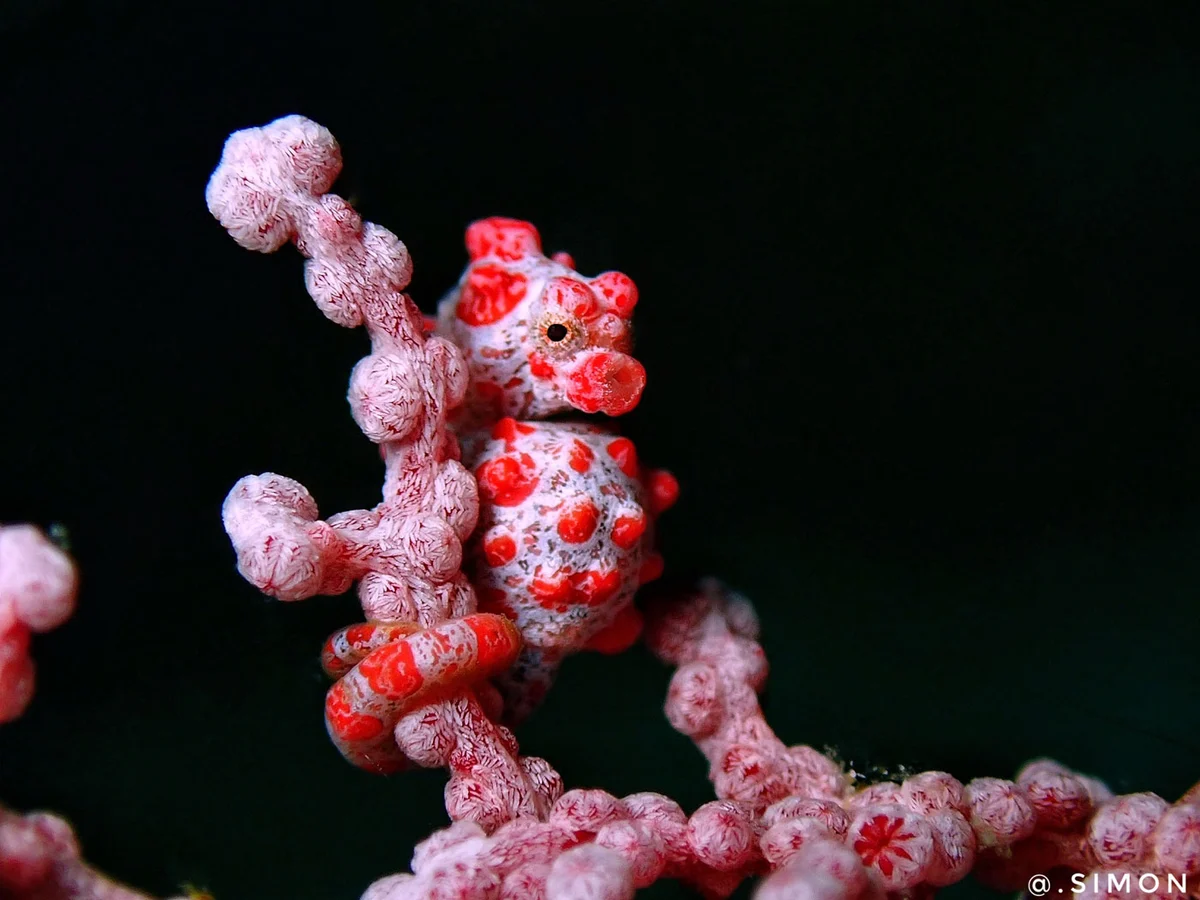
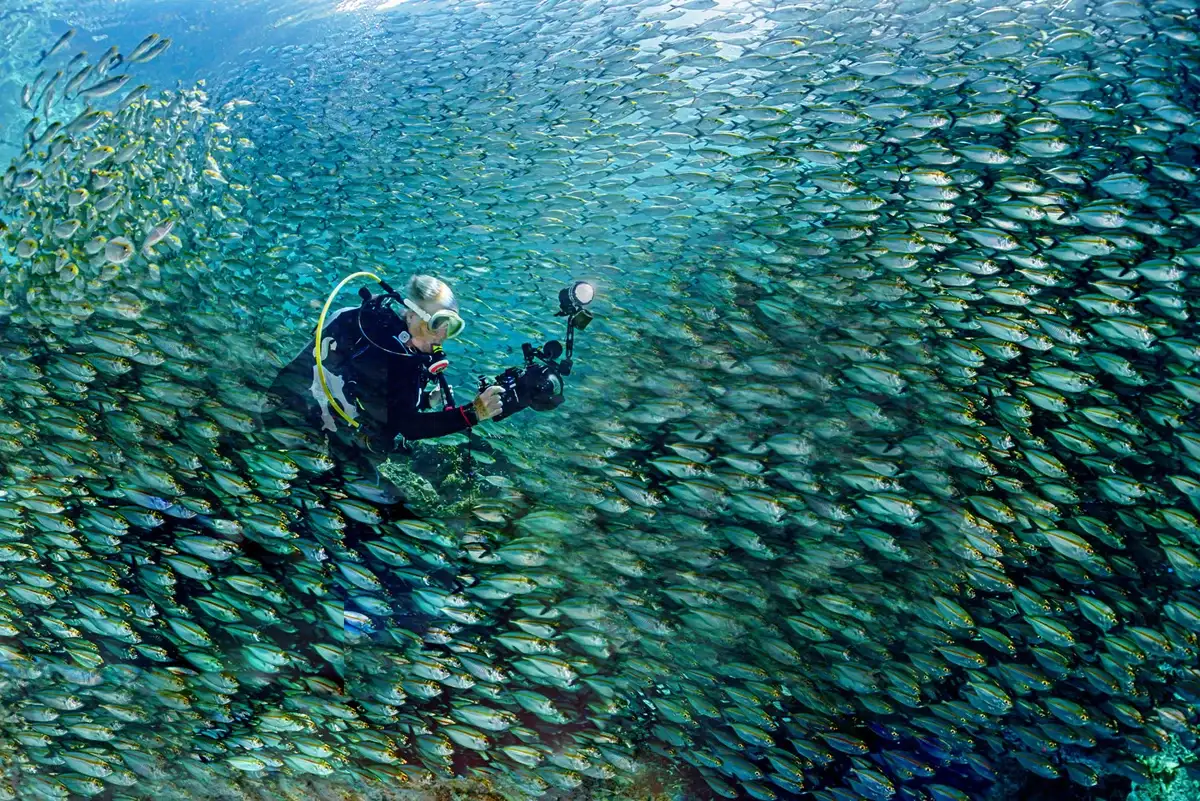
Proco Island itself, the palm-covered uninhabited island at the heart of the barrier cluster, has a 900-metre house reef at Jebeje where shoals of yellow-lined snapper move above soft corals alongside sweetlips in conditions very different from the strait's main current dives. Bukit Karang, a specialised site within this area, is one of the few places in the world where three species of pygmy seahorse can be found on a single dive: Bargibanti, Denise's, and Pontohi, each occupying a different structural niche within the same reef.
Migrating whales and dugongs pass through the Patinti Strait seasonally — encounters that depend on timing and cannot be guaranteed, but occur with enough frequency to be a genuine possibility across a week-long stay.
Sali Kecil
Set within a protected bay in the Patinti Strait, Sali Kecil offers calmer conditions than the main channel sites and a house reef extensive enough that multiple days of diving rarely cover the same ground twice. Hard and soft corals cover the sloping reef in high density, and the resident marine life includes reef sharks, dolphins, pilot whales, tuna, and schooling batfish alongside a strong macro inventory: pygmy seahorses, painted frogfish, and rare shrimps distributed across the reef structure.
The Halmahera Epaulette Shark is regularly encountered on night dives here. It is not confined to Sali — sightings occur at Proco and across the island group's reef systems — but the sheltered conditions and accessible slope make nocturnal exploration at Sali particularly well suited to finding one.
Kusu Island
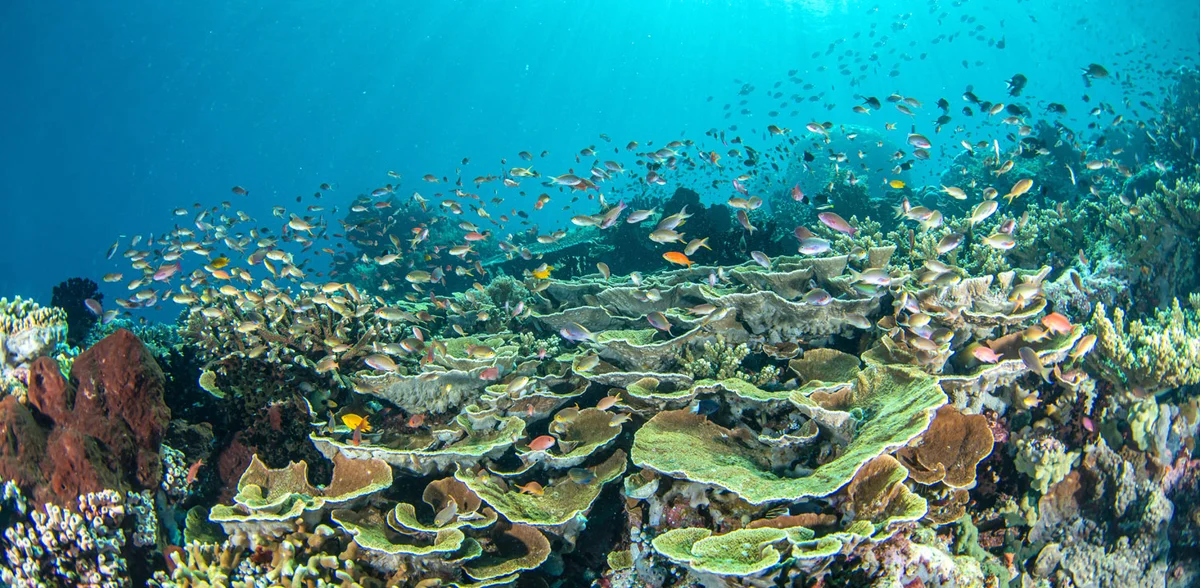
Kusu operates as a private marine sanctuary, and the protection that designation affords is visible in the water. The house reef holds more than 3,000 fish species — a figure that places it among the most species-rich reef systems in the region — with mantas, reef sharks, schooling jacks, bobtail squid, cuttlefish, and lionfish all appearing in regular rotation. White sand channels and coral bommies provide a varied topography that supports sustained exploration across multiple dives without repetition.
Thoru Point, located close to the island, is considered one of the most visually striking reefs in the area: curving sandy slopes and exceptionally healthy coral formations with an unusual density of reef fish. It is a site that holds attention across repeated dives without requiring any particular specialisation from the diver.
Bacan Island
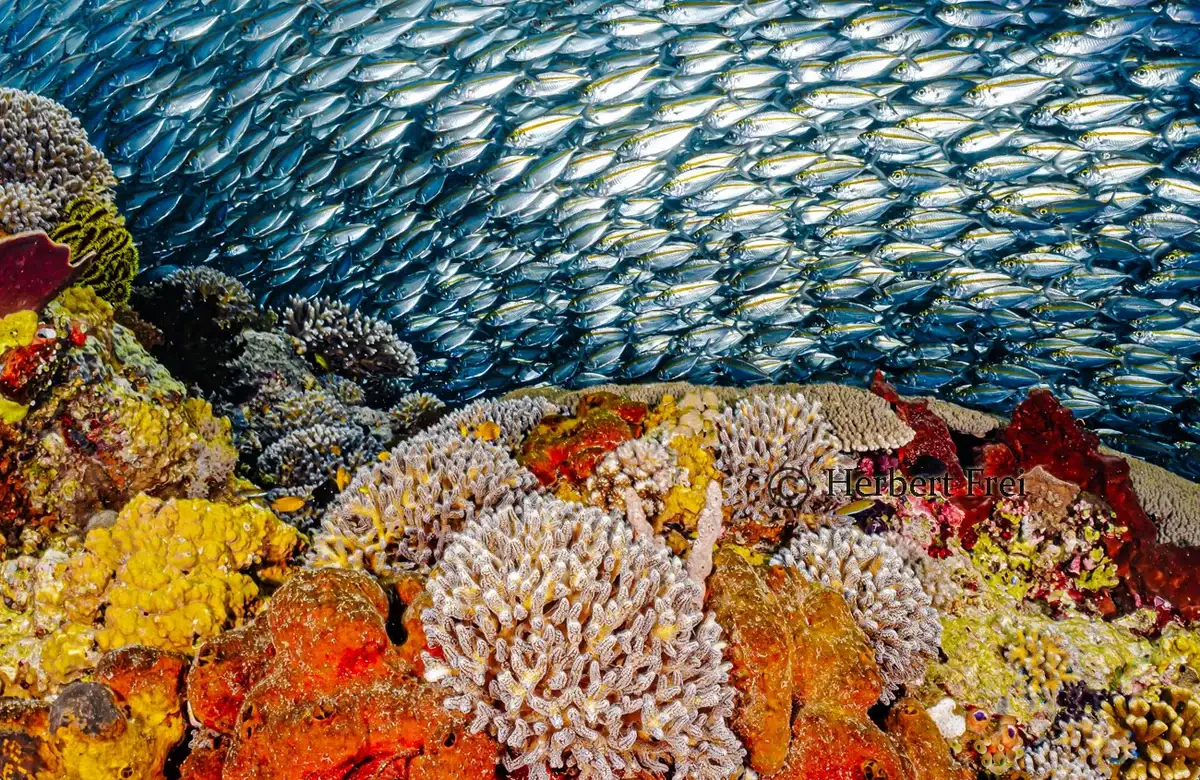
Bacan bounds the western side of the Patinti Strait and offers a diving character distinct from the current sites and the island reefs. Its coastline is defined by volcanic black sand slopes where frogfish, ghost pipefish, cuttlefish, and rare nudibranchs inhabit the darker substrate in the manner of the renowned muck environments further south. The deeper walls transition to a different register, with schooling barracuda, jacks, Napoleon wrasse, and reef sharks among the soft coral formations along the drop-offs.
Babang Bay is the principal macro site. Off Bacan's southern coast, near the small island of Pigaraja, a sunken wooden cargo ship provides the wreck diving the other islands largely lack.
Bacan and the nearby island of Ternate carry historical weight beyond their diving. Both were the original and primary global source of cloves and nutmeg during the sixteenth and seventeenth centuries — the product that drove European colonial expeditions across the world and placed these two small islands at the centre of the global economy for over a century. The fortifications and port infrastructure of that era remain visible in both islands' towns.
The Goraici Islands
Southwest of Halmahera, the Goraici archipelago — Siko, Gafi, Laigoma, and Tomakomafatu — offers pristine outer-reef diving largely undisturbed by the main resort circuits. Vertical walls drop to 50 metres, covered in sponges and sea fans at a density that indicates minimal disturbance. Blacktip reef sharks, Napoleon wrasse, and large schools of snapper inhabit the structure throughout. The night diving here, at sites including Siko Island and Batu Oranje, is among the most rewarding in the region, with macro species emerging from the reef into open water in conditions that reward patience and a slow pace.
Topside: Wallacea and the Spice Islands
The terrestrial character of these islands is as unusual as the marine. Halmahera sits within Wallacea, and the birds of the region include species found nowhere else on earth — among them Wallace's Standardwing, a bird of paradise with iridescent green breast shields that Alfred Russel Wallace himself first documented here in the 1850s. Active volcanoes visible from the resort islands are accessible for trekking. The Spice Islands history of Bacan and Ternate — their colonial-era fortifications, trading ports, and the plantation landscapes that produced the goods that once made them the most valuable real estate on earth — is accessible from both ports as an independently arranged excursion. These are not activities the dive resorts organise, but both Labuha on Bacan and Ternate town are within reach for guests who want a day away from the water.
When to Visit
The dry season runs from March to November. Within this window, June to October provides the most consistently calm surface conditions and the best visibility — up to 40 metres at the pelagic sites in the strait. Water temperatures stay between 27°C and 30°C, though deep-water upwellings in the channel can bring this down to 25°C on some dives.
October to December is the peak window for whale shark sightings, overlapping the end of the dry season and the transition into wetter months.
The wet season runs from December to February. Surface conditions at the exposed strait sites can be rougher during this period, but the sheltered bays around Sali and Kusu remain diveable throughout. The nutrient-rich conditions of the wet season trigger an increase in macro life activity at the calmer sites, and visibility in sheltered water remains adequate for close-focus reef diving.
Getting There
The principal entry points are Ternate Airport (TTE) and Labuha Airport (LAH) on Bacan Island, both reached via domestic connections from Jakarta or Manado. Depending on flight availability, an overnight layover in Manado or Ternate is frequently necessary before the final leg. From either port, private speedboats operated by the island resorts complete the transfer — a journey of one to three hours depending on the destination island.
Planning Your Trip
South Halmahera's remoteness is part of its character. A minimum stay of five to seven days is the practical threshold for covering both the strait's current sites and the calmer island reefs — the two environments complement each other and reward time spent across both. Most resorts operate on all-inclusive packages covering accommodation, diving, and transfers. The overnight layover in Ternate or Labuha, an inevitable part of the routing, provides a natural opportunity to explore the Spice Islands towns before reaching the resort — the resorts we work with here can advise on transfer options from both ports.