The Four Kings: The Complete Diver's Guide to Central Raja Ampat
An archipelago of 1,500 islands at the heart of the Coral Triangle, where migration corridors bring mantas, turtles and cetaceans through the Dampier Strait, walking sharks hunt the shallows at night, and a single dive at Cape Kri has logged more fish species than anywhere else on earth.
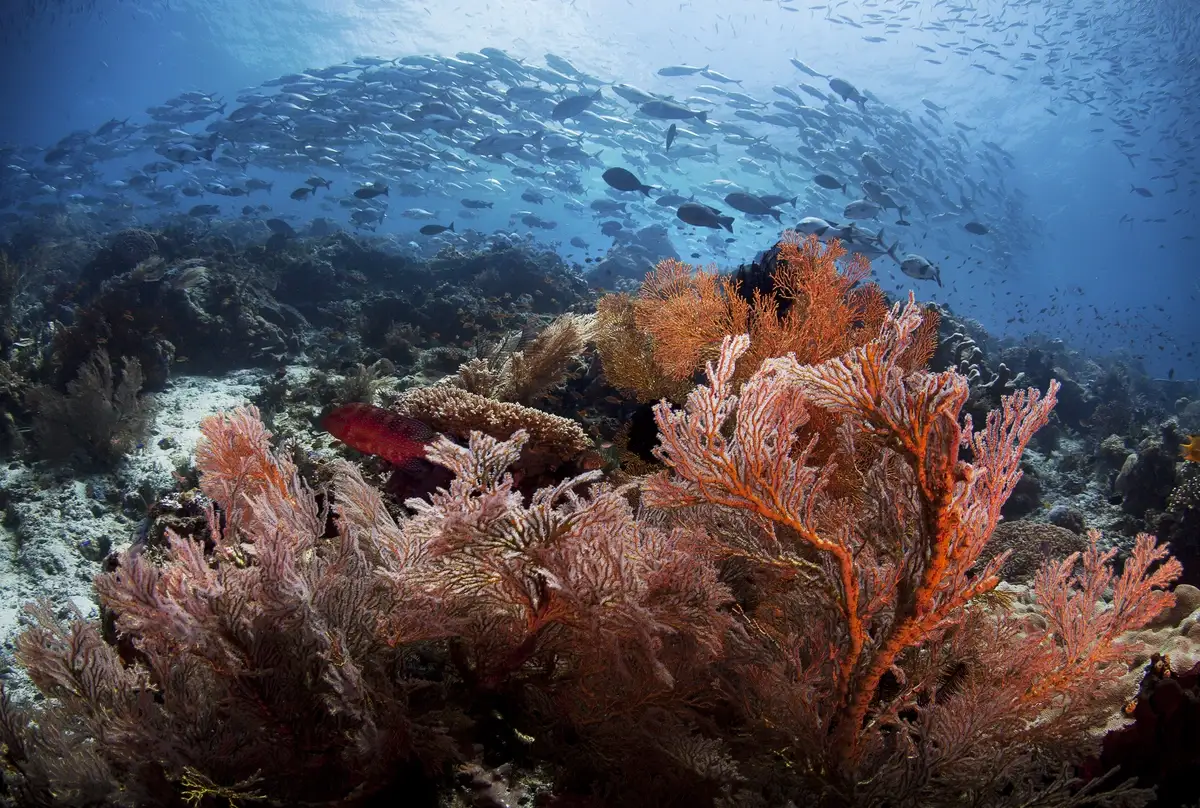
Raja Ampat — the Four Kings — lies off the northwestern tip of the Bird's Head Peninsula in West Papua, Indonesia, surrounding its four namesake islands of Waigeo, Batanta, Salawati, and Misool with more than 1,500 smaller islands, cays, and shoals. This is the acknowledged heart of the Coral Triangle: the archipelago holds over 600 species of hard coral — approximately 75 per cent of all hard coral species known to science — and between 1,600 and 1,800 species of reef fish. No other location on earth concentrates reef biodiversity at this scale. The Dampier Strait and Sagewin Strait, the major channels running through the central islands, carry the Indonesian Throughflow — the persistent current connecting the Pacific and Indian Oceans — which pushes large volumes of water through these narrow passages and creates the conditions that sustain everything that lives here.
The results of this geography are visible on every dive. A single dive at Cape Kri holds the documented world record for fish species observed in one dive: 374 distinct species. The Dampier Strait supports 32 distinct shark species within a single marine protected area spanning 366,000 hectares. The endemic Raja Ampat Epaulette Shark — which moves across the seafloor on its pectoral and pelvic fins rather than swimming — occurs in the Dampier Strait at densities five to ten times higher than the rest of Raja Ampat. These are not exceptional days. They represent the baseline.
At a Glance
| Best time to visit | October to April |
| Manta ray peak | November to March |
| Diving season | Year-round; central Dampier Strait accessible throughout |
| Water temperature | 27°C - 30°C year-round |
| Visibility | 25-30m dry season; 10-20m wet season |
| Getting there | Fly to Sorong (SOQ); ~2 hrs speedboat to Waisai |
The Migration Corridors
The Dampier and Sagewin Straits function as bottlenecks in a set of migration routes that bring large marine animals through the central islands year-round, and understanding the corridors explains much of what divers encounter here.
The most studied is the reef manta ray corridor. Satellite tracking has mapped a 150-kilometre migration route running from Wayag lagoon in northern Raja Ampat south through the Dampier Strait. Reef manta rays (Mobula alfredi) use this route to move between aggregation areas, feeding grounds, and reproductive sites, shifting their position in rhythm with seasonal monsoon changes and plankton availability. The practical consequence for divers is that the cleaning stations at Manta Sandy, Manta Ridge, and Pulau Dayang are fixed points on a known migration circuit rather than isolated sightings. Peak concentrations run from November through March when plankton density is highest.
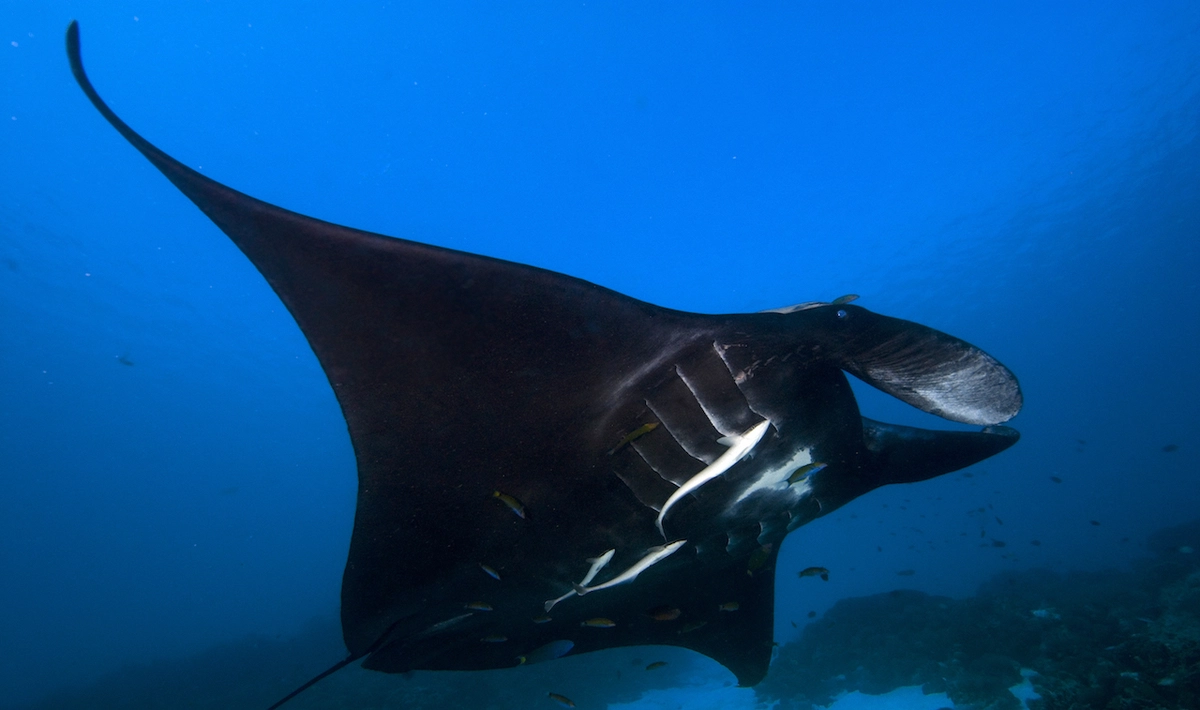
The same channel geography that concentrates mantas also acts as a bottleneck for cetaceans moving between the Pacific and Indian Oceans. Dolphins and whales — several species have been recorded — pass through the Dampier and Sagewin Straits during seasonal transits, and encounters from the surface and occasionally at depth are a recurring feature of time spent in the region.
Green, hawksbill, and leatherback sea turtles use these waters as a migratory corridor between foraging grounds and nesting beaches. The most significant nesting site in the area is Abun, on the Bird's Head Peninsula's north coast, and the turtles moving toward it pass through the Dampier Strait's reef systems. Turtle encounters on the reef flat, at cleaning stations, and resting under overhangs are consistent across virtually every site in the strait throughout the year.
Kri Island
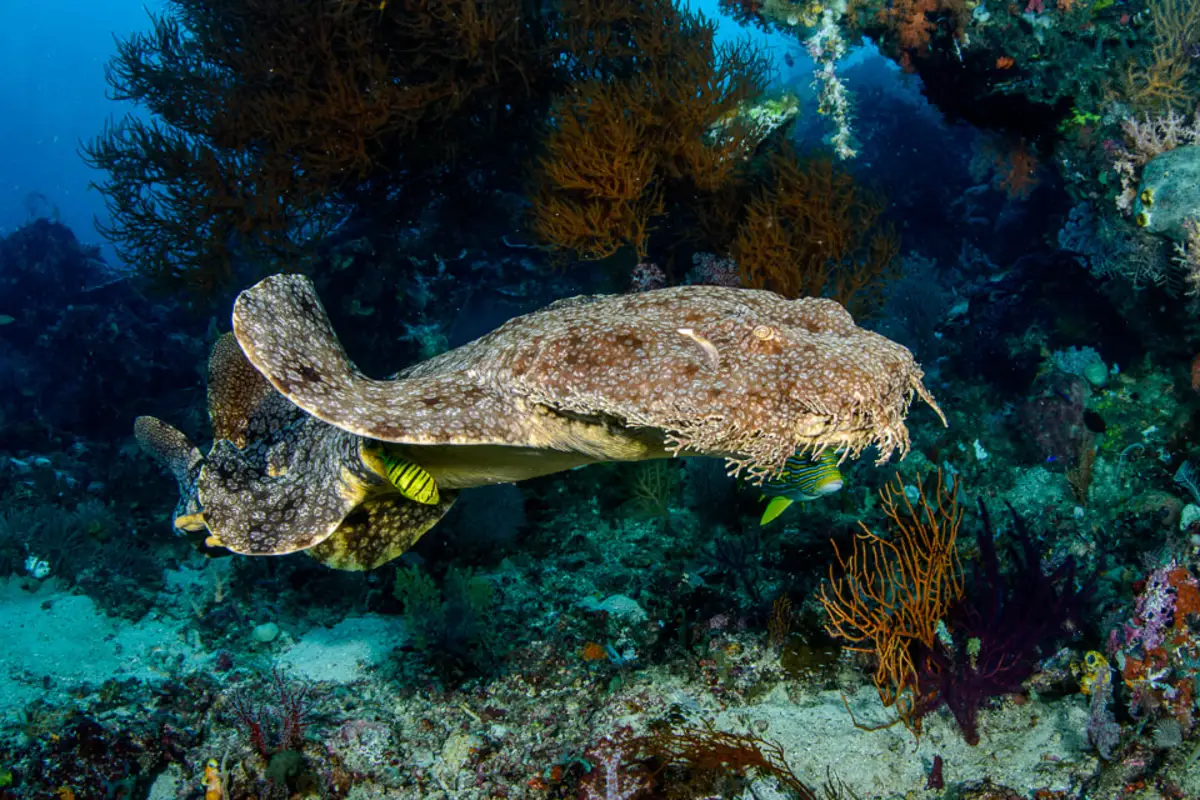
Cape Kri, at the northern point of Kri Island, is where the fish species record was set. An intermediate to advanced drift dive across sloping reefs and large submerged pinnacles, the site holds the kind of animal density the number suggests — swarms of barracuda, fusiliers, trevally, and snappers at different depths simultaneously, with wobbegong sharks settled on the reef structure below.
What the record figure does not convey is the ecological significance of the site beyond its fish count. Since 1995, the reef flat at Cape Kri has hosted a continuous aggregation of juvenile blacktip reef sharks — groups of 20 to 50 animals observed in the same location year-round for three uninterrupted decades. In Sorido Bay, on the same island, pregnant female blacktip reef sharks are a regular presence. The site that holds the fish species record is simultaneously one of the most significant shark nursery zones documented in the Indo-Pacific.
This nursery pattern extends across the strait's human infrastructure. The sandy substrates, coral reefs, and seagrass beds beneath the jetties and water bungalows of the major dive resorts in the Dampier Strait serve as documented nursery habitat for juvenile blacktip reef sharks — groups of 10 to 50 animals present year-round beneath every major jetty structure in the region. What reads as an accessible house reef dive is also functioning nursery habitat. The two things are not in tension; they are the same place.
Sardine Reef, a 200-metre-long submerged pinnacle reaching to around 30 metres, sits close to Kri and requires a negative entry in strong current. The reward is dense, rotating schools of jacks, snappers, and bumphead parrotfish working the pinnacle in conditions that fully justify the technique required. Chicken Reef offers lively reef domes in more moderate current, with dense schooling fish and occasional manta and reef shark encounters in conditions that suit a wide range of experience levels.
Mansuar Island
Mansuar Island lies close to Kri in the Dampier Strait, and Manta Sandy — a shallow sandy channel running to a maximum of 10 to 20 metres — is among the most consistently productive manta cleaning stations in the central region. Reef mantas position over the sandy bottom while cleaner wrasse work their gills and skin; the shallowness of the site makes the encounter accessible across all experience levels in typically gentle current. The village jetties at Sawandarek and Yenuba, nearby on the same island group, offer pristine coral gardens, giant clams of considerable age, turtles, and dense schools of fish sheltering beneath the wooden structures.
Gam Island
Batu Lima — Five Rocks — sits on the eastern side of Gam Island where five formations break the surface and connect below the waterline through a network of canyons, ledges, and coral overhangs. It is the only true wall dive in central Raja Ampat, the walls dropping to 24 to 25 metres and covered in dense populations of brilliant pink and purple gorgonian sea fans visible within a few metres of the surface. Schooling pickhandle barracuda, giant trevally, and blacktip and whitetip reef sharks work the open water around the rocks during the day. Currents run mild to moderate, and the site is productive across experience levels.
After dark, the character changes entirely. The shallow water between 3 and 5 metres becomes active hunting ground for the Raja Ampat Epaulette Shark, which emerges to walk across the sandy substrate between the rock formations. Survey data places epaulette shark density in the Dampier Strait at 1,030 to 2,340 individuals per square kilometre — five to ten times the regional average for the rest of Raja Ampat. Batu Lima's night dives also produce sleeping hawksbill turtles on the reef, crocodile fish settled into the sand in near-perfect camouflage, blue-spotted stingrays, and electric clams pulsing in the gaps between the rocks. The site that demands attention to current by day becomes unhurried and accessible after nightfall.
The Passage — Kabui Passage — is a narrow channel separating Gam and Waigeo islands, where the jungle canopy extends directly over the water and filters light down onto shallow soft corals and mangrove roots below. Archerfish hunt at the surface alongside the mangrove community. It is one of the few dive environments anywhere where the boundary between the terrestrial and marine ecosystems is only the waterline — the two systems are genuinely continuous. Yangeffo, along the Gam coastline, offers two contrasting sites: Mayhem is a high-energy seamount with sustained barracuda and shark aggregations in strong current; Citrus Ridge carries dense orange soft coral growth and resident tasselled wobbegong sharks that use the coral rubble as cover.
Waigeo: The South Coast
The south coast of Waigeo faces the Dampier Strait's stronger currents and open-water character. Blue Magic is a compact seamount rising from depth, positioned within the manta migration corridor, and one of the few sites in the central region where oceanic mantas — rather than reef mantas — occasionally appear. Hammerhead sharks have been recorded here. The current is demanding and the site rewards experience with the water movement. Manta Ridge, on the same coastline, is a high-current aggregation and cleaning site where larger numbers of mantas gather than at the sheltered stations closer to shore; surge is a consistent factor throughout.
Mike's Point provides a contrasting wall environment enriched with underwater ledges, caves, and large resident schools of snappers that hold position across multiple dives. It offers the vertical character of the south coast sites in conditions that are less subject to the open current of Blue Magic and Manta Ridge.
Batanta Island
Batanta is one of the four main islands, and its southwest corner presents a complete contrast to the Dampier Strait's coral architecture. The substrate here is black volcanic sand and silt, and the sites — Black Beauty, Critter Hunt, Algae Patch, and Batu Hitam — hold the cryptic inventory that dark sand supports: mimic octopuses, flamboyant cuttlefish, ghost pipefish, frogfish, blue-ringed octopuses, and nudibranchs across sloping substrate that rewards slow, close observation. It is an entirely different kind of diving from the walls and pelagic sites of the central strait, and its proximity makes it a natural counterpoint within any multi-day itinerary. Pulau Dayang, off Batanta's coast at 15 to 20 metres, serves as a manta ray cleaning station in calmer, shallower conditions — a gentler alternative to Manta Ridge for manta encounters.
The Fam Islands
West of the Dampier Strait, the Fam Islands are a cluster of karst limestone formations with turquoise lagoons and some of the most intact hard coral coverage in the broader region. Melissa's Garden is a submerged plateau widely considered the finest hard coral garden in Raja Ampat — dense with anthias and small reef fish at every depth band, the coral structures undisturbed by the stronger currents that characterise the strait's main sites. Penemu Wall and My Reef, on the outer edges of the same island group, are steep-wall and channel drift dives where the topography and current combine in ways that contrast sharply with the sheltered plateau of Melissa's Garden.
The Village Reefs
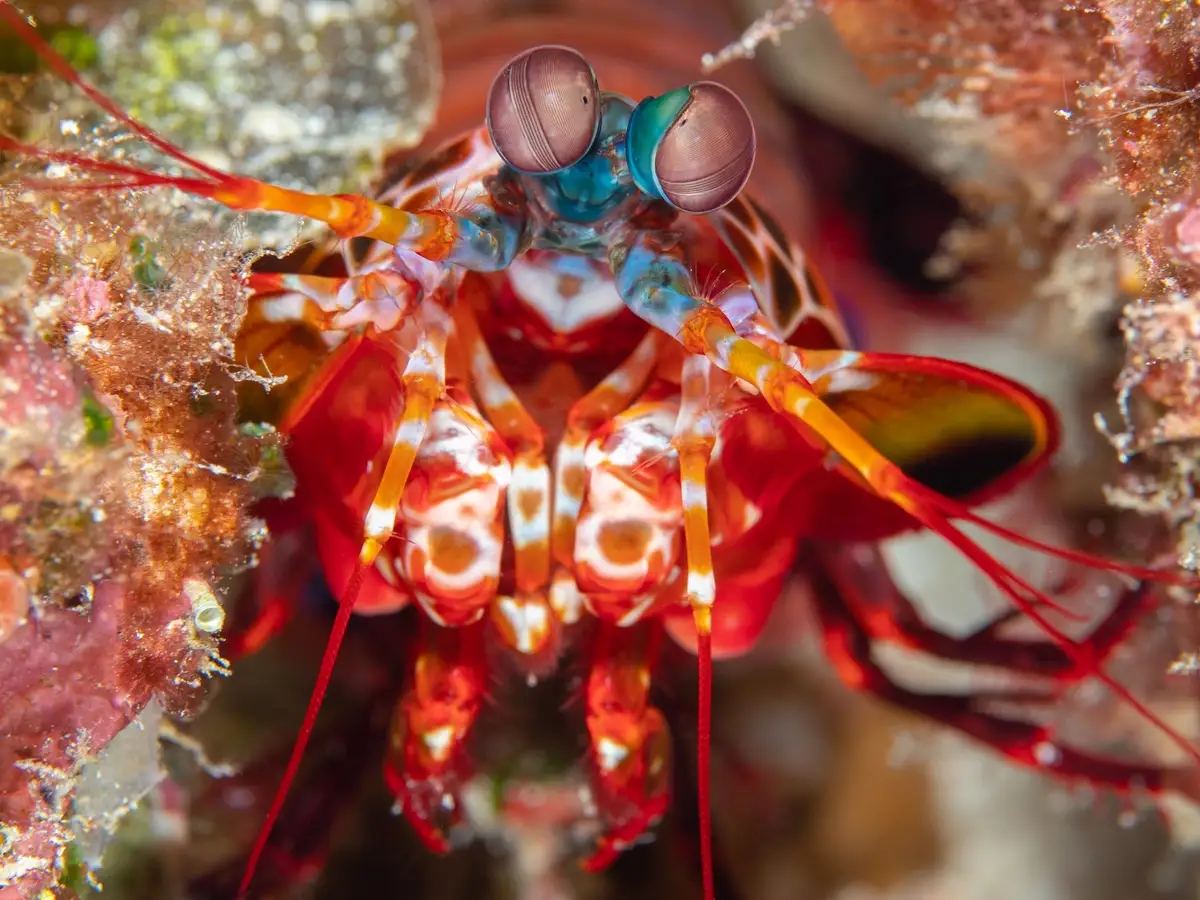
Several sites in the Dampier Strait are calm and shallow, and described accordingly as accessible entry points — but that description understates what they contain. Arborek Jetty, at a small local village island, is a dive on wooden pilings draped in soft corals and home to giant clams, pygmy seahorses, ornate ghost pipefish, schooling batfish, and the juvenile blacktip reef sharks documented beneath every major jetty structure in the strait. It is a macro site, a coral garden, and a shark nursery simultaneously. Mioskon, a sheltered platform reef in the Dampier Strait, provides extended bottom times in a mixed environment of sandy patches and coral bommies, with mantis shrimp, bobtail squid, and resident wobbegong sharks among the consistent encounters. Night dives here are productive without the current management the outer sites require.
Across the Dampier Strait's reef sites, assessments of hard coral communities have documented a depth pattern worth noting: coral cover is highest at around 3 metres, but overall species diversity peaks slightly deeper at 6 metres. Time spent in the 3 to 6 metre range tends to yield more species per dive than heading straight to depth — a detail that applies across most sites in the central region.
When to Visit
The dry peak season runs from October to April. Surface conditions are at their calmest, and visibility reaches 25 to 30 metres across the main sites. The manta cleaning stations are at peak activity from November through March when plankton density in the strait is highest and the migration corridor is most concentrated.
Diving remains fully viable during the wet southeast monsoon season from May to September. Stronger winds restrict access to the southern sectors — Misool is largely inaccessible during this period — but the central Dampier Strait retains its shelter. The islands create protected microclimates that keep Kri, Gam, Mansuar, and Arborek operational through the wet months. Visibility drops to 10 to 20 metres due to rain runoff and cold-water upwelling, but this upwelling is the mechanism that sustains the reef's food chain — the biology that produces a dry-season visit is being replenished in the wet months. There are significantly fewer divers in the water, and the reef encounters are no less productive for it.
Water temperature holds between 27°C and 30°C year-round.
Getting There
The gateway to Raja Ampat is Sorong Airport (SOQ) in West Papua, served by domestic flights from Jakarta, Bali, and Makassar. From Sorong, a speedboat of approximately two hours crosses to Waisai, the main port of Raja Ampat on Waigeo Island. Resorts arrange onward transfers from Waisai; the leg from Waisai to resort ranges from a few minutes to a further hour depending on location within the central island group.
Planning Your Trip
Central Raja Ampat diving is based from resorts located across the Dampier Strait islands — Kri, Gam, Mansuar, and the surrounding smaller islands, with some resorts on Batanta for access to the muck sites. A stay of seven nights is the practical minimum for covering the full range of site types: the current-driven reef and pelagic sites, the manta cleaning stations, Batanta's volcanic sand diving, the Fam Islands, and night diving. The wet season restriction on southern sectors is the main planning variable; divers wanting to include Misool should book within the October-to-April window — the resorts we work with in the central islands span Kri, Gam, Mansuar, and Batanta, and the right base depends largely on which sites are the priority.