The Moon and the Reef: Coral Spawning, Mantas and the Lunar Calendar
The Moon reaches a diver twice, once through the tide and once through the animals that keep time by it. What the records show for coral spawning at Lankayan and Mabul, and what is known about mantas.
The Moon reaches a diver in two ways. The first is indirect: it sets the size of the tide, and with it the strength of the current, through a fortnightly rhythm of spring and neap tides. That is covered in our article on tides, monsoons and currents. The second is direct. A number of reef animals time parts of their lives by the Moon, and the most spectacular of them is the coral spawn.
The lunar calendar in brief
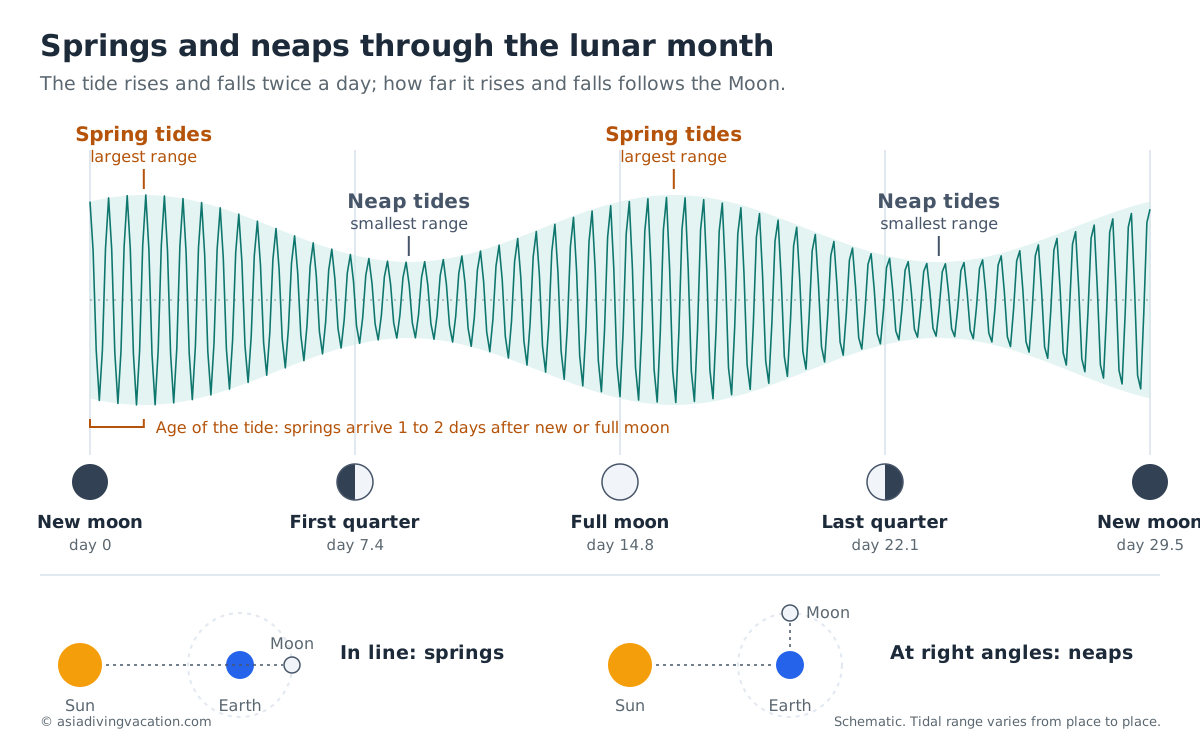
The Moon takes about 29.5 days to go from new to full and back. Spring tides, the largest of the fortnight, follow a day or two after new and full moon; neap tides, the smallest, follow the quarter moons. The tide also keeps pace with the Moon through the day, arriving about 50 minutes later each day (Bowers and Roberts, 2019).
Shore animals have long been known to keep this time. Some crabs and other intertidal creatures continue to follow a twice-daily and a fortnightly rhythm for days after being moved into a laboratory with no tides at all, which points to internal biological clocks set by the tide (Bowers and Roberts, 2019).
Coral spawning
Most reef-building corals reproduce by releasing eggs and sperm into the water, many colonies on the same few nights (Baird, Guest and Willis, 2009, give a full review). Where and when that happens has been collected in the Indo-Pacific Coral Spawning Database, which brings together thousands of observations from across the region (Baird et al., 2021). Two of our destinations are in it.
Lankayan
Lankayan has the most complete record of any of our destinations: 32 observations of corals spawning on the reef, from 2012 to 2015 and again in 2019 (Baird et al., 2021). Every one of them falls in April or May, and nearly all are Acropora, the branching and table corals that make up much of the reef. The spawning came between three days before and four days after the full moon, most often on the night of the full moon itself, and from about forty minutes to three hours after sunset, most often around two hours.
A study of the spawning at Lankayan added the tide to the picture. Acropora spawned an hour after slack low tide, as the flood began and surface currents picked up, during the full moon of 25 to 27 April (Chung, Mustafa and Manjaji-Matsumoto, 2015).
That puts the Lankayan spawn on spring tides, near full moon, in the weeks after the northeast monsoon eases. The resort reopens in March after its January and February closure.
Mabul
The Mabul records are fewer and more spread out: 15 observations, in 2007 and 2009, in March, April, June, July and August, between three and seven days after the full moon and mostly one to two and a half hours after sunset (Baird et al., 2021). Corals around Mabul appear to spawn over several months rather than in a single April event, though with two years of records it is too early to call that a pattern.
Elsewhere in the region
The database has no spawning records from the Derawan islands, Lembeh, Halmahera, Raja Ampat, Ambon or Triton Bay. That is a gap in the observations, not evidence that the corals do not spawn there. For comparison, corals at Karimunjawa in the Java Sea were recorded spawning in October and November, two to three days after the full moon (Tomascik et al., 1997, in Baird et al., 2021).
Seeing it
A spawning dive is a night dive, timed from the lunar calendar and the hour of sunset, on reef that the resort's guides know. Even in a good year, not every colony spawns on the predicted night, and the dates move with the full moon from year to year. Spawning near full moon also means spring tides, so currents in channels can be strong on exactly the nights the corals are most likely to spawn.
Manta rays
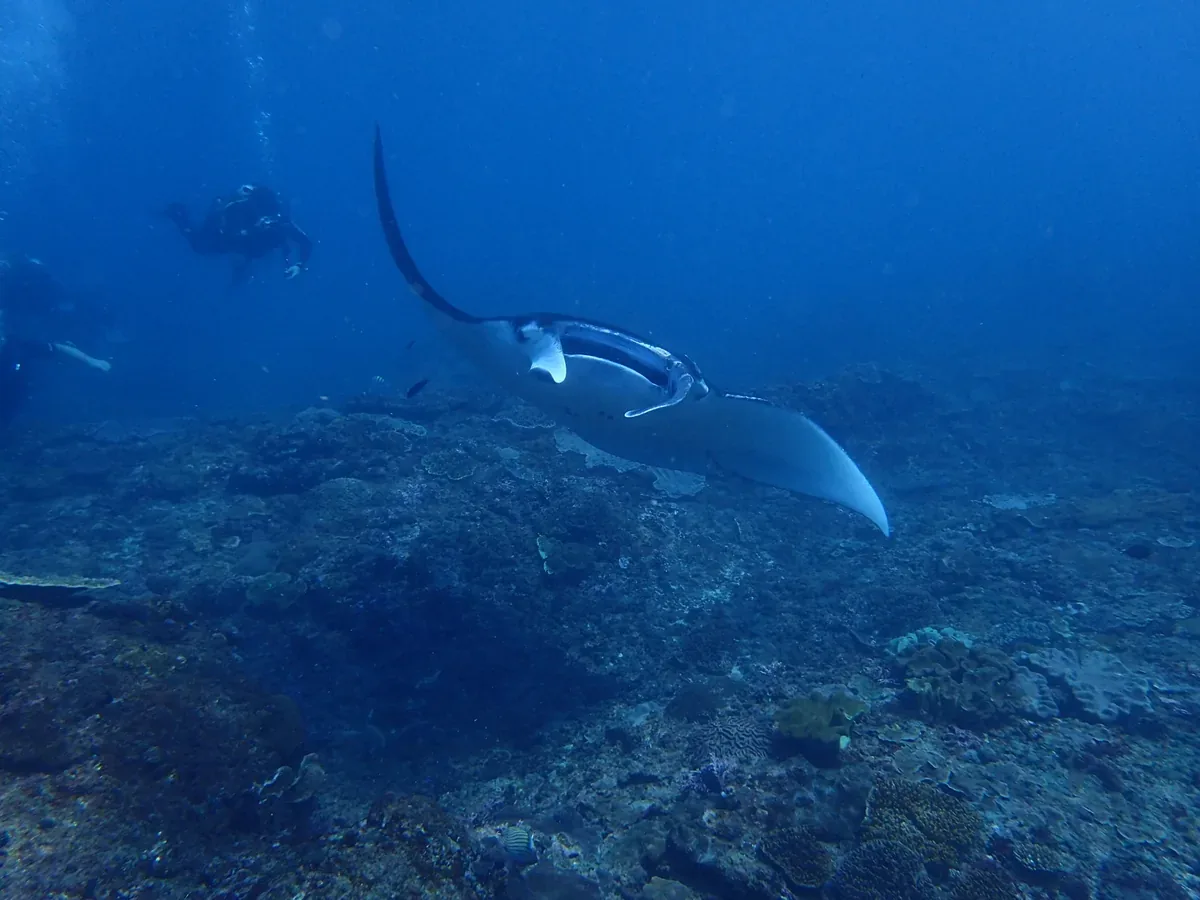
The most detailed study of mantas and the Moon comes from Lady Elliot Island on Australia's Great Barrier Reef, outside our region, where dive operators logged reef manta sightings over three years. More mantas were seen around new and full moon. Mantas visiting cleaning stations were seen most around high tide and in the first hours of the ebb, while feeding mantas increased with tidal range and peaked about four hours after high tide (Jaine et al., 2012).
The nearest Indonesian evidence comes from Komodo National Park, outside the destinations we cover. There, manta visits to the central sites increased on spring tides, around new and full moon, when currents and the movement of water are greatest (Dewar et al., 2008, cited in Germanov et al., 2022). In the Maldives, mantas at one cleaning station were detected most often close to full moon, about three hours after high tide, and on days with little wind (Harris and Stevens, 2021).
No study of tide or moon effects has yet been published for Raja Ampat or the Derawan islands. What is established locally is the season and the time of day. Acoustic tags on 41 oceanic mantas in Raja Ampat, tracked from 2016 to 2019, showed visits to cleaning stations in central Raja Ampat mainly from December to April, with Blue Magic the main site, and in southern Raja Ampat mainly from April to December. Nearly all visits, 94 per cent, came in daylight, peaking around noon (Setyawan et al., 2024). Reef mantas in Raja Ampat peak from November to March; at Sangalaki in the Derawan islands they are present all year (see our Central Raja Ampat and Derawan guides).
Moonlight and night dives
Every night, much of the ocean's plankton and many small fish and shrimp rise from the depths towards the surface, where they feed in the dark, and sink again before dawn. They keep to a level of dim light that hides them from predators, so a bright moon holds them deeper. Off Hawaii, some lanternfish rose to within 25 metres of the surface on new-moon nights but came no shallower than 75 to 100 metres under a full moon, and catches in shallow night tows fell as the moon brightened (Drazen, De Forest and Domokos, 2011). Around the reefs of Mo'orea in French Polynesia, moonlight likewise held back both the plankton and its predators from the surface waters where larval reef fish live (Shima et al., 2021).
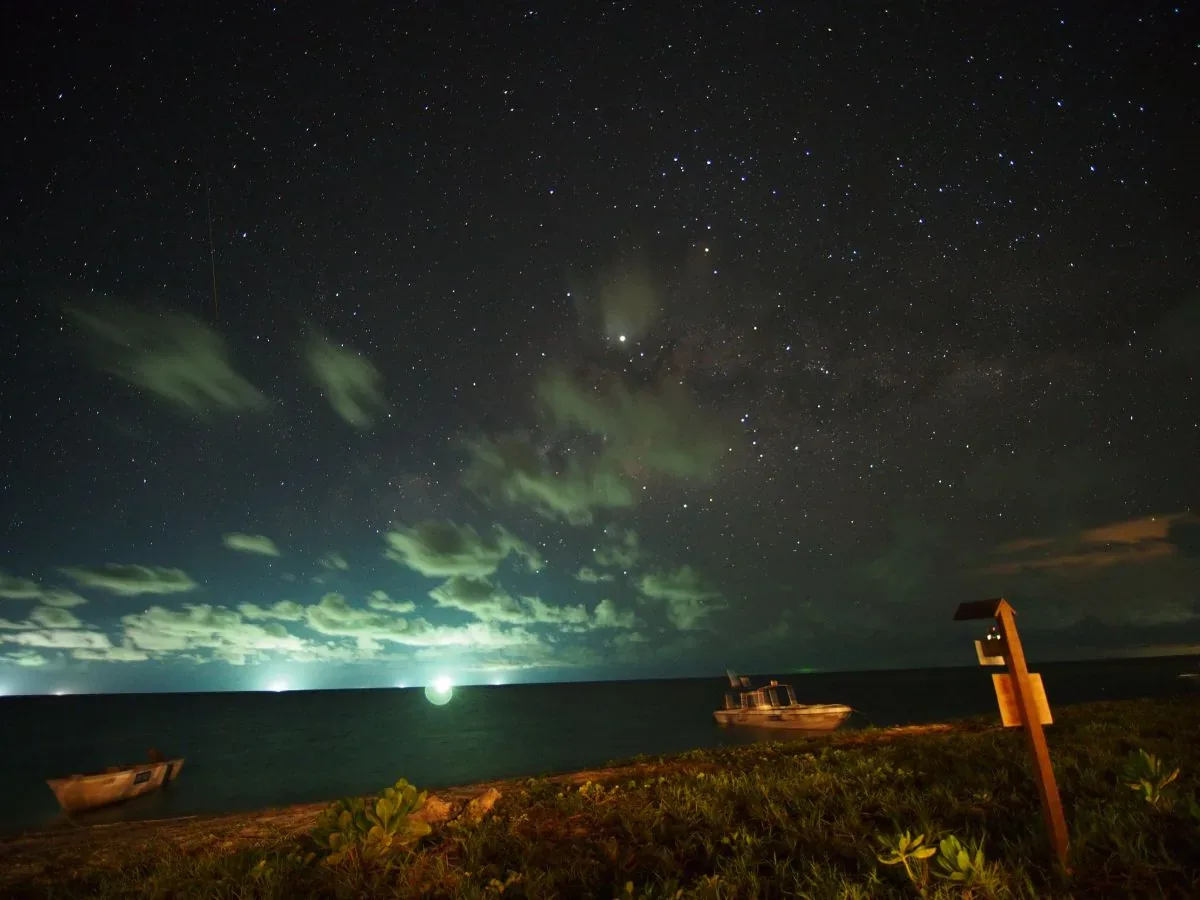
Neither study is from our region, and neither was about divers. They point in the same direction, though: the dark nights around new moon are the better bet for a night dive that looks for drifting animals in open water, and a full moon is the better night for seeing the reef itself by natural light.
The sea worm swarm of Maluku
In Maluku, including around Ambon, sea worms known locally as laor rise from the reef to spawn at the surface in March or April. The swarm comes on the second and third nights after the full moon, in the dark between sunset and moonrise, and on the second night the surface can turn red with worms. Catching them, timba laor, is a long-standing local tradition (Mahulette, 2020).
Planning around the Moon
A trip planned around the Moon starts with the month and then the night. For a chance of seeing corals spawn at Lankayan, the records point to April, and to the nights around the April full moon. For drift dives, spring tides around new and full moon bring the strongest currents of the fortnight, and neap tides around the quarter moons the gentlest. The year's calendar of full moons is published well in advance, and a local tide table gives the hour.
Sources
- Baird, A. H., Guest, J. R. and Willis, B. L. (2009). Systematic and biogeographical patterns in the reproductive biology of scleractinian corals. Annual Review of Ecology, Evolution, and Systematics, 40, 551–571. doi:10.1146/annurev.ecolsys.110308.120220
- Baird, A. H., Guest, J. R., Edwards, A. J., Bauman, A. G., Bouwmeester, J., Mera, H., et al. (2021). An Indo-Pacific coral spawning database. Scientific Data, 8, 35. doi:10.1038/s41597-020-00793-8. Data: doi:10.25405/data.ncl.13082333
- Bowers, D. G. and Roberts, E. M. (2019). Tides: A Very Short Introduction. Oxford University Press.
- Chung, F. C., Mustafa, S. and Manjaji-Matsumoto, B. M. (2015). Hydrodynamic conditions and spawning timing of leopard coralgrouper Plectropomus leopardus and stony coral Acropora spp. in Lankayan Island, Sabah, Malaysia. 2nd International Conference on Marine Science and Technology, abstract P-61.
- Drazen, J. C., De Forest, L. G. and Domokos, R. (2011). Micronekton abundance and biomass in Hawaiian waters as influenced by seamounts, eddies, and the moon. Deep-Sea Research I, 58(5), 557–566. doi:10.1016/j.dsr.2011.03.002
- Germanov, E. S., Pierce, S. J., Marshall, A. D., Hendrawan, I. G., Kefi, A., Bejder, L. and Loneragan, N. (2022). Residency, movement patterns, behavior and demographics of reef manta rays in Komodo National Park. PeerJ, 10, e13302. doi:10.7717/peerj.13302
- Harris, J. L. and Stevens, G. M. W. (2021). Environmental drivers of reef manta ray (Mobula alfredi) visitation patterns to key aggregation habitats in the Maldives. PLoS ONE, 16(6), e0252470. doi:10.1371/journal.pone.0252470
- Jaine, F. R. A., Couturier, L. I. E., Weeks, S. J., Townsend, K. A., Bennett, M. B., et al. (2012). When giants turn up: sighting trends, environmental influences and habitat use of the manta ray Manta alfredi at a coral reef. PLoS ONE, 7(10), e46170. doi:10.1371/journal.pone.0046170
- Mahulette, F. (2020). Traditionally catching and processing of laor in Moluccas Islands. Local Wisdom: Jurnal Ilmiah Kajian Kearifan Lokal, 12(2), 99–110. doi:10.26905/lw.v12i2.4078
- Setyawan, E., Mambrasar, R., Sianipar, A. B., Hasan, A. W., Putra, M. I. H., Mofu, I., Beale, C. S. and Erdmann, M. V. (2024). Insights into the visitations of oceanic manta rays at cleaning stations on coral reefs in the Bird's Head Seascape, eastern Indonesia. Frontiers in Fish Science, 2. doi:10.3389/frish.2024.1432244
- Shima, J. S., Osenberg, C. W., Noonburg, E. G., Alonzo, S. H. and Swearer, S. E. (2021). Lunar rhythms in growth of larval fish. Proceedings of the Royal Society B, 288, 20202609. doi:10.1098/rspb.2020.2609
- Tomascik, T., Mah, A. J., Nontji, A. and Moosa, M. K. (1997). The Ecology of the Indonesian Seas, Part One. Periplus.